Via Pandagon
Feb. 13th, 2008 05:06 pm![[personal profile]](https://www.dreamwidth.org/img/silk/identity/user.png) roadrunnertwice
roadrunnertwiceI hear a mighty buzzing noise, and it sounds like... freedom.
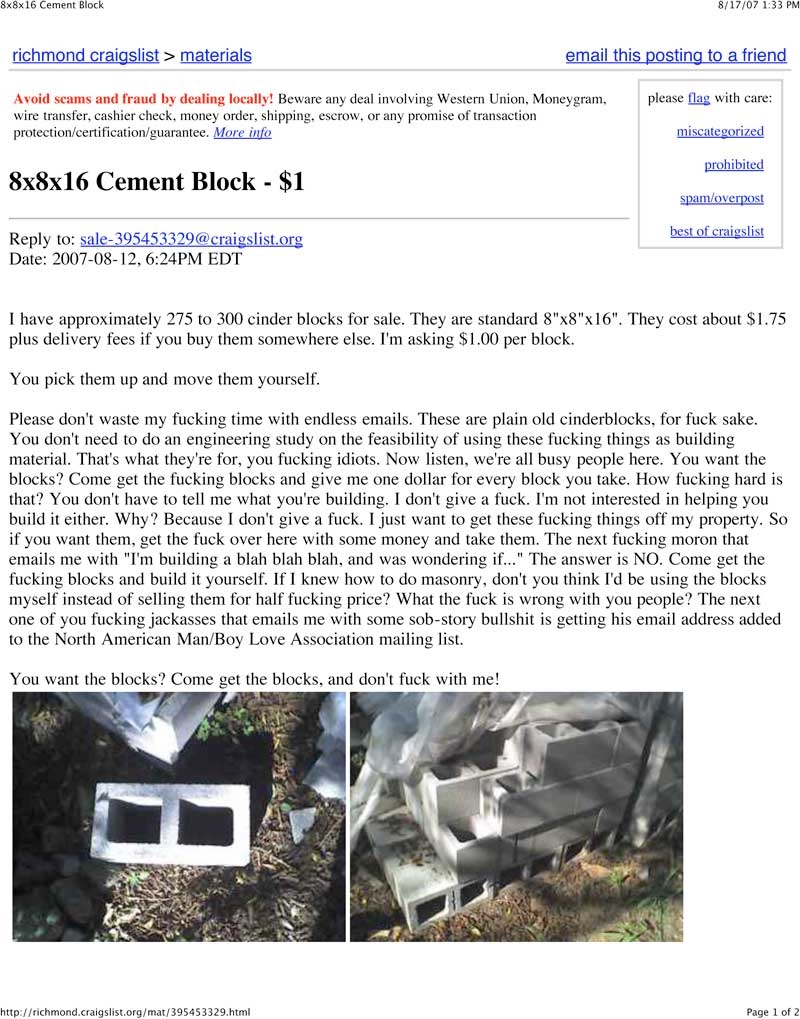
EDIT: Also, via Daring Fireball: The most aggressive cinderblock ad EVER.
EDIT: I've changed my mind. This is definitely a low-mid grade flu rather than a cold. At least I'm getting over it fairly easy this year? I still feel crappy, but I'm not totally miserable.
EDIT: Ft. Lewis is doing nighttime shelling exercises tonight. It's kind of like a thunderstorm, except more irritating.
EDIT: Also, via Daring Fireball: The most aggressive cinderblock ad EVER.
EDIT: I've changed my mind. This is definitely a low-mid grade flu rather than a cold. At least I'm getting over it fairly easy this year? I still feel crappy, but I'm not totally miserable.
EDIT: Ft. Lewis is doing nighttime shelling exercises tonight. It's kind of like a thunderstorm, except more irritating.
no subject
Date: 2008-02-14 01:43 am (UTC)no subject
Date: 2008-02-14 05:30 am (UTC)no subject
Date: 2008-02-14 06:36 am (UTC)Maybe I'm not understanding your viewpoint.
no subject
Date: 2008-02-14 06:47 am (UTC)Generally the constitution doesn't care when state governments ban most any type of commercial good, so why does it care in this case? Why are sex toys an exception to the rule?
no subject
Date: 2008-02-14 07:31 am (UTC)...and I'm thinking, wasn't the gist behind Lawrence that the state, in fact, has no such thing?
This sex toy ban _explicitly_ exists to police private sexual expression, which I understand to be constitutionally protected from state policing. You're giving credence to the state's commercial vs private argument, right? I don't have a very firm grip on that legal briar, but here's how I understand it: The state's entire reasoning for the ban is that it wants to prevent non-hetero/non-binary/non-procreative sex acts, and Lawrence says that these acts are not things the state is allowed to prevent. If the state had some reason for the ban that didn't stem from an intention to suppress constitutionally protected behavior, maybe it could make it stand? And if you're right that states can ban whatever they want to for whatever reason (your clarification to
But let's turn it around for a better view: Say a state were to say that while you have a right to bear arms, you're not allowed to sell them, whether person-to-person, through the mail, or in a store. Would that hold up? (That's not rhetorical; I really have no clue.) Or turn it around again: Say a state, citing a serious public health concern, were to ban the sale of all sex toys containing toxic materials that have been previously banned from children's toys?* I can't see any way you could use Lawrence to bat that one down, can you?
As best as I can tell, the court is reading this ban as an unconstitutional attempt to police private sexual morality, and is brushing off as irrelevant the fact that it's a supply-side attack rather than a demand-side one. As far as the legal standing of that ruling, I'm clueless.
_____
* Just as a sidenote, I am 100% in favor of this. Currently, the materials one can make a dildo out of are completely unregulated, and a lot of them are made with the kinds of softened plastics that the government has decided should not go in children's mouths. I can't imagine they're any better for adults when they're in contact with sensitive mucus membranes, and I don't think there are generally labels informing people that their new toy is made out of poison.
no subject
Date: 2008-02-14 08:24 am (UTC)Your argument is good, and I don't have a very good response to it except to say that sex toys are much more peripheral to sex than guns are to...guns. Banning sale of sex toys doesn't prevent sexual relationships between anyone, and though it might make an individual's favorite form of sex more difficult, it seems like this decision creates a constitutional safe-zone for anything that relates to sex. No other such constitutional safe-zone exists for anything but free speech.
I guess I'd have to know what other kinds of laws this new right would strike down. Surely the state can ban dangerous sex toys, but can they make aesthetic decisions? Can they ban "realistic" sex toys? They might not have a good reason, but does banning realistic sex toys diminish their functionality to the extent that it's an end-run around Lawrence?
Sorry if any of this doesn't make sense. It's time for bed.
no subject
Date: 2008-02-14 01:16 pm (UTC)And I disagree with your stance on state plenary power. States cannot ban anything they want on a whim; the right to free expression necessarily means that every act must be legal *unless* the state can show a compelling interest in banning it. Thus any law must have an established rationale, which can be challenged in court.
If somebody went into court challenging a law, and the representives of the State defended the law by saying "Eh, we felt like banning succotash," the law would be struck down immediately.
no subject
Date: 2008-02-14 05:43 pm (UTC)no subject
Date: 2008-02-14 06:33 pm (UTC)Of course, I'd argue that every act is, in fact, a possible form of expression and that therefore the burden is always on the state to demonstrate that a law both supports a compelling interest and does so in the least restrictive manner possible, but the courts have generally not agreed.
no subject
Date: 2008-02-14 08:35 pm (UTC)no subject
Date: 2008-02-15 01:25 am (UTC)